Go to content | Go to main menu | Go to search
You are here: Pet Hardware Rivets & Screws Rivets & Burrs Brass Rivets & Burrs
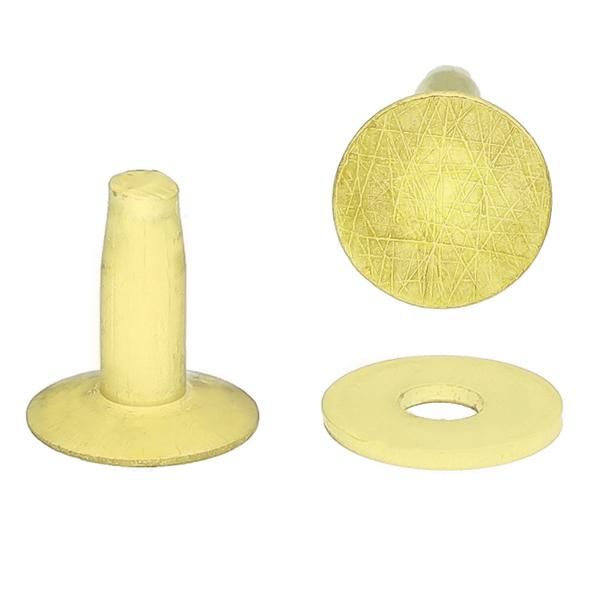
Brass head on the face, peened burr on the back. Brass rivets and burrs go on leather belts, cases and flap bags, where mostly one side of the joint is on show.
The shank is 3 or 4 mm in diameter and 14 to 26 mm long; the head is 9 or 12 mm. We pack rivets with a 3 mm shank in 75s and those with a 4 mm shank in 50s.
Brass has a warm golden tone that matches brass buckles and rings. For reddish hardware, take copper rivets and burrs.
Blog post: How to attach copper rivets
Enter your email and we'll send you one notification when this product is back in stock. Nothing more.
You've signed up for back in stock notifications. We'll let you know as soon as this item is available again.
By the total thickness of all the layers you're joining. Once the rivet is through the material, leave at least 5 mm between the top layer and the point where the shank starts to taper, so there's room for the burr and for setting.
A longer shank is fine: you snip off the excess once the burr is seated. That's why you don't choose the length the way you would for standard saddlery rivets. The shank length is listed on each rivet's product page in the variants table as dimension B.
For joining waterproof or Hexa webbing, we recommend a double cap rivet: 70 Z 13 mm for three layers, 79 Z 15 mm for four layers.
Push the rivet through the prepared hole and fit the burr onto the shank from the other side.
Drive the burr down to the material with the setter, using several lighter blows.
Trim the shank with end cutters so that 2–4 mm remain above the burr.
Form the head. Tap the bevelled end down with a hammer and finish it with the setter's cup. Run a finger over the finished rivet: no sharp edge should remain.
You'll find the step-by-step photos in the guide How to attach copper rivets.
Match it to the shank diameter and make it with a hole punch of the same size. The rivet has to pass through the material but mustn't wobble in the hole. The shank diameter is listed on each rivet's product page in the variants table as dimension A.
The shank won't pass through a hole that's too small, or you'll damage the material. In a hole that's too big, the rivet won't sit firmly and the joint may not hold.
Besides the rivets and burrs, have these ready:
a hole punch or punch pliers for the hole,
a rivet and burr setter; for copper rivets we stock a copper rivet setter,
a hammer,
end cutters to trim the shank,
a solid work surface, such as a small anvil or a granite slab.
