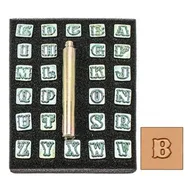
Craftool 6 mm Open Face Alphabet Set. Letters and a handle packaged in a handy storage box.
● In stock
19.11 € / pc
Prices include 21% VAT. More about VAT and customs fees.

Craftool 6 mm Open Face Alphabet Set. Letters and a handle packaged in a handy storage box.
● In stock
19.11 € / pc

Craftool 3 mm (1/8") Alphabet & Number Set. Includes letters A through Z, numbers 0 through 9, ampersand, @ and handle.
● In stock
from 25.49 € / pc

Craftool 6 mm (1/4") Standard Number Set. Numbers and a handle packaged in a handy storage box.
● In stock
12.74 € / pc

Craftool 13 mm (1/2") and 19 mm (3/4") Standard Number Set. Numbers and a handle packaged in a handy storage box.
● In stock
from 21.66 € / pc

2D leather stamp with a bull head motif. Our intricately detailed stamps speed your leatherwork.
● In stock
5.09 € / pc

Mini 2D leather stamp with a cat motif. Our intricately detailed stamps speed your leatherwork.
● In stock
3.81 € / pc

Craftool Celtic 3-D Stamp Set. The twelve detailed 30 mm stamps show classic Celtic knots and braids.
● In stock
50.99 € / pc

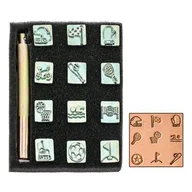
Decorate leather medals and trophies for your athletes with these twelve sports-themed half-inch (13 mm) stamps.
● In stock
53.65 € / pc 67.06 €

Combine the four 10–13 mm stamps into a continuous barbed wire border on anything from key chains to shields.
● In stock
31.86 € / pc

Add a continuous 5 mm wide Celtic border to belt and bag edges.
● In stock
31.86 € / pc

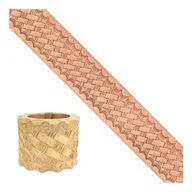
With this 25 mm wide brass-cast roll you decorate belts, bracelets, straps and other leather goods.
● In stock
194.85 € / pc

With this 29 mm wide brass-cast roll you decorate belts, bracelets, straps and other leather goods.
● In stock
194.85 € / pc

With this 30 mm wide brass-cast roll you decorate belts, bracelets, straps and other leather goods.
● In stock
194.85 € / pc

With this 32 mm wide brass-cast roll you decorate belts, bracelets, straps and other leather goods.
● In stock
194.85 € / pc

With this 40 mm wide brass-cast roll you decorate belts, bracelets, straps and other leather goods.
● In stock
155.88 € / pc 194.85 €

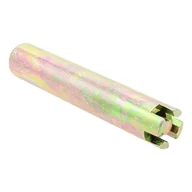
A heavy handle for large 2D and 3D stamps and for 3/4" (1.9 cm) and 1" (2.5 cm) alphabet and number sets.
● In stock
19.11 € / pc

The standard handle for 2D and 3D stamps and for alphabet and number sets from 1/2" (1.3 cm) up to 1" (2.5 cm).
● In stock
5.09 € / pc

Fits stamps and sets smaller than 1/2", including our 1/8" (3 mm) and 1/4" (6 mm) alphabet and number sets.
● In stock
3.81 € / pc
What the parameters mean and how to choose the right values.
Pavla's hands-on view – what caught her attention and what to watch out for when making and choosing.

I use zinc-alloy stamps for hand stamping dampened vegetable-tanned cowhide, preferably 2 mm thick or more. On thinner leather the impression comes out shallow, and a harder strike can cut right through. Before I choose a motif, I compare its size from the table on the stamp with the space I actually have on the collar, strap or wallet.
Alphabet and number sets work well for initials, a name or a phone number on a collar. I choose the letter size by the width of the piece and the length of the text; a long name will not fit on a narrow strap in the largest size. These stamps are not made for hot stamping or bookbinding; that calls for brass ones.

The most common questions – materials, selection and practical tips.
For classic stamping, we recommend leather about 2 mm thick or more, that is medium-thick or thick cowhide leather.
A stamp needs a certain thickness of material to make an impression that is deep enough. On thinner leather the impression will be shallower, and too much force can damage the grain side.
Leather around 1 mm can be stamped, but the impression will not be as deep or distinct. Work carefully and test the stamping on an offcut of the same leather first, as heavy force risks cutting through.
You can convert a thickness given in ounces (oz) to millimetres in the leather thickness converter.
The best results are usually achieved on vegetable-tanned leather.
This type of leather responds well to moistening and allows a clean, lasting impression. On very soft, chrome-tanned or heavily finished leather, the stamping may not be as pronounced.
Natural cowhide leather is best suited to decorating with stamps, and you can dye it after stamping. The differences between the types of leather are explained in the Leather Guide.
For ordinary hand stamping, a mallet is used.
With very thin leather, controlled pressure in a press may be more suitable, because the force can be increased gradually, reducing the risk of cutting through the material. In either case, test the stamping on an offcut of the same leather first.
We do not recommend a metal hammer.
For hand stamping, a plastic or other non-metal mallet is more suitable. This reduces the risk of damaging both the handle and the stamp itself with repeated blows.
Yes, if you use too much force.
Correct stamping should compress the material and create an impression, not cut it through. The risk of cutting through is higher mainly with thin leather and with stamps that have fine, narrow parts. Increase the pressure or the force of the blow gradually and stamp on a firm, flat surface, for example on a granite slab.
No, our stamps are made of zinc alloy and are intended for hand stamping into moistened leather.
For regular hot work and bookbinding, stamps designed specifically for hot work are used, most often brass ones.
A regular pattern on a belt, strap or collar can be made faster with embossing rolls than with individual stamps.
You fit the roll on an embossing machine with a 25 mm shaft and pull a strip of leather through it, so the pattern forms continuously along the whole length. Before choosing, check the width of the pattern and whether the roll fits your machine.
 37 years supplying hardware to makers and workshops, 103,325 customers so far.
 Hardware, leather and tools under one roof. For collars, leashes, halters, belts and handbags.
 Buy more, pay less. You see pack and carton prices and any order-value discount before paying.