Leather thickness converter
A US leatherworking guide calls for "4–5 oz leather", but your callipers read millimetres. Enter a value or range in ounces to see the millimetre equivalent and matching leather in stock.
Convert oz to mm
Leather is a natural material, so allow for a ±0.2 mm tolerance within a single hide.
Not sure about the thickness? Pick what you're making
We'll recommend a range in ounces and millimetres, plus matching leather in stock.
Complete leather thickness table
1 oz = 0.396875 mm · rounded to 0.1 mm| oz | mm | Typical use | In stock |
|---|---|---|---|
| 1–2 oz | 0.4–0.8 mm | Linings, interior padding, fine details | Thin (0.8–1.5 mm) → |
| 2–3 oz | 0.8–1.2 mm | Small pouches, fine leather goods | Thin (0.8–1.5 mm) → |
| 3–4 oz | 1.2–1.6 mm | Wallets, card holders, light bags | Thin (0.8–1.5 mm) → |
| 4–5 oz | 1.6–2.0 mm | Wallet exteriors, handbags, notebook covers, reinforced belts | Medium (1.6–2.5 mm) → |
| 5–6 oz | 2.0–2.4 mm | Soft bags, handbags, small dog collars | Medium (1.6–2.5 mm) → |
| 6–7 oz | 2.4–2.8 mm | Collars, leashes, lighter belts | Thick (2.6–4.0 mm) → |
| 7–8 oz | 2.8–3.2 mm | Belts, large dog collars, bag straps | Thick (2.6–4.0 mm) → |
| 8–9 oz | 3.2–3.6 mm | Sturdy belts, leashes, heavy-duty bags | Thick (2.6–4.0 mm) → |
| 9–10 oz | 3.6–4.0 mm | Sheaths/holsters, harness straps | Thick (2.6–4.0 mm) → |
| 10–12 oz | 4.0–4.8 mm | Saddles, harnesses, heavy sheaths | Extra thick (4.1 mm+) → |
| 12–14 oz | 4.8–5.6 mm | Soles, extreme-wear parts | Extra thick (4.1 mm+) → |
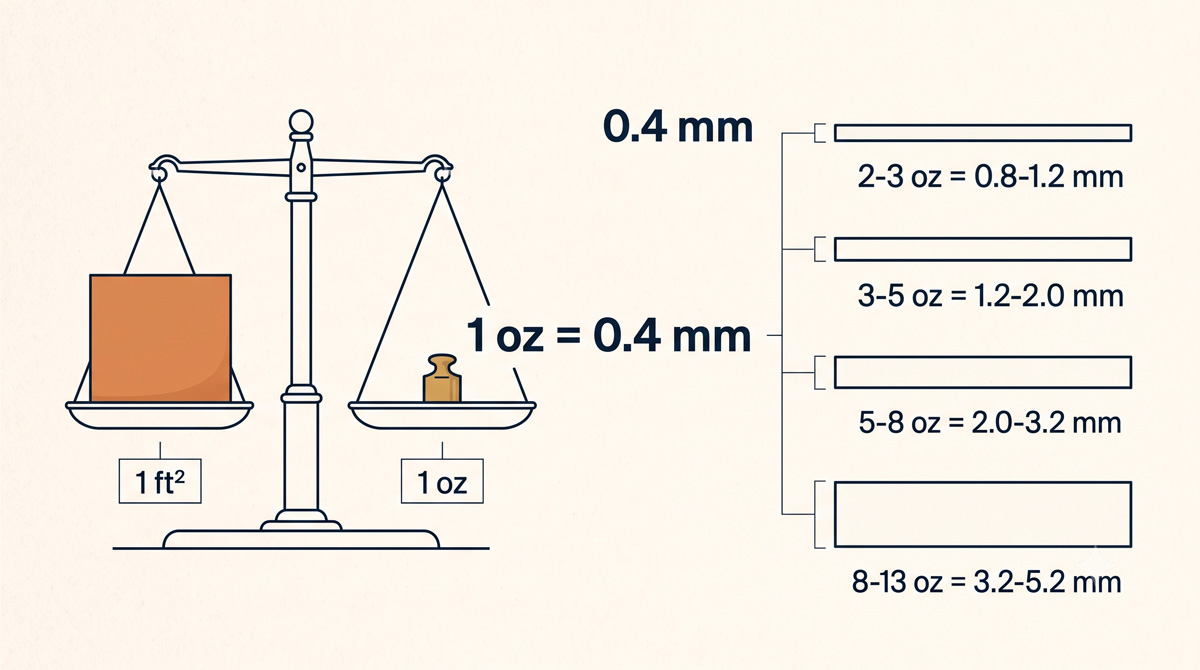
Why is leather thickness measured in ounces?
In the US, leather thickness is commonly expressed in ounces. The convention originated in weight per square foot; today, each ounce represents approximately 1/64 inch (0.4 mm) of thickness. For example, 4 oz leather is about 1.6 mm thick.
Leather is sold in ranges such as "4–5 oz" because a hide is not equally thick throughout. The back is generally thicker than the flanks, and splitting improves consistency without eliminating variation. A 4–5 oz range corresponds to 1.6–2.0 mm; allow for a ±0.2 mm variation within an individual hide.
Measure the leather with callipers in several places because it tends to be thinner near the edge. When using a micrometer, apply as little pressure as possible: compressing the leather produces a lower reading.
We stock leather from 0.8 to 5.2 mm. The links on this page open the matching catalog filter for the displayed range: thin, medium, thick or extra thick.
Frequently asked questions
Exactly 0.396875 mm. In practice, count on 1 oz ≈ 0.4 mm — you won't notice the difference on a finished piece.
7–9 oz (2.8–3.6 mm) for most belts — enough body to hold its shape and take a buckle, while still being easy to skive and stitch.
The recommended thickness depends on the size of the dog:
Small dogs: 5–6 oz (2.0–2.4 mm).
Large dogs: 7–9 oz (2.8–3.6 mm).
Extra-large, powerful breeds (mastiffs, Rottweilers): 9–10 oz (3.6–4.0 mm), or a two-layer construction.
Thickness alone isn't enough, though: at the buckle the leather has to bend, and even a fairly thin strap can crack on the top side unless you skive (thin down) the flesh side at the fold first.
The top-grain layer is the strongest part of the hide, but it still has a limit to how far it stretches. If the flesh side isn't thinned at the fold, the outer surface has to travel a much longer path than the inner side when bent — and it cracks, sometimes just fine surface cracking, sometimes right through.
The fix: skiving the flesh side down to roughly half the original thickness at the fold releases that tension so the bend can flex without damage.
It's the same as “4–5 oz”: a range, not a fraction.
Leather is a natural material and splitting to an exact single weight isn't realistic, so it's sold in ranges instead.
6–8 oz (2.4–3.2 mm) works for most leashes — strong enough for a dog's pull and still comfortable to fold and stitch.