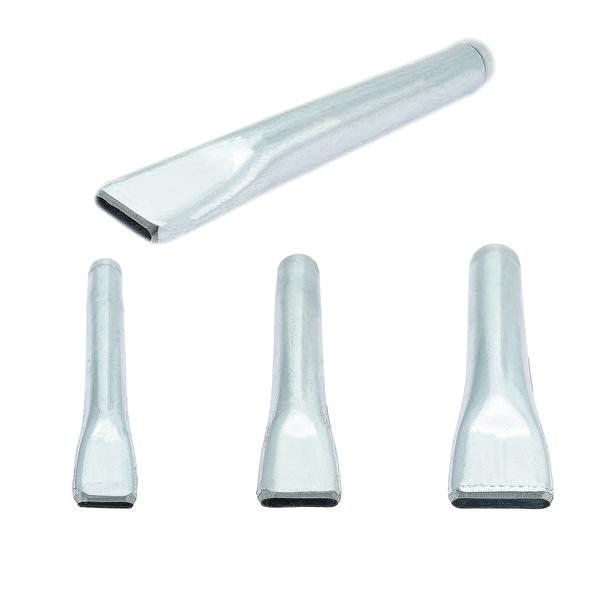
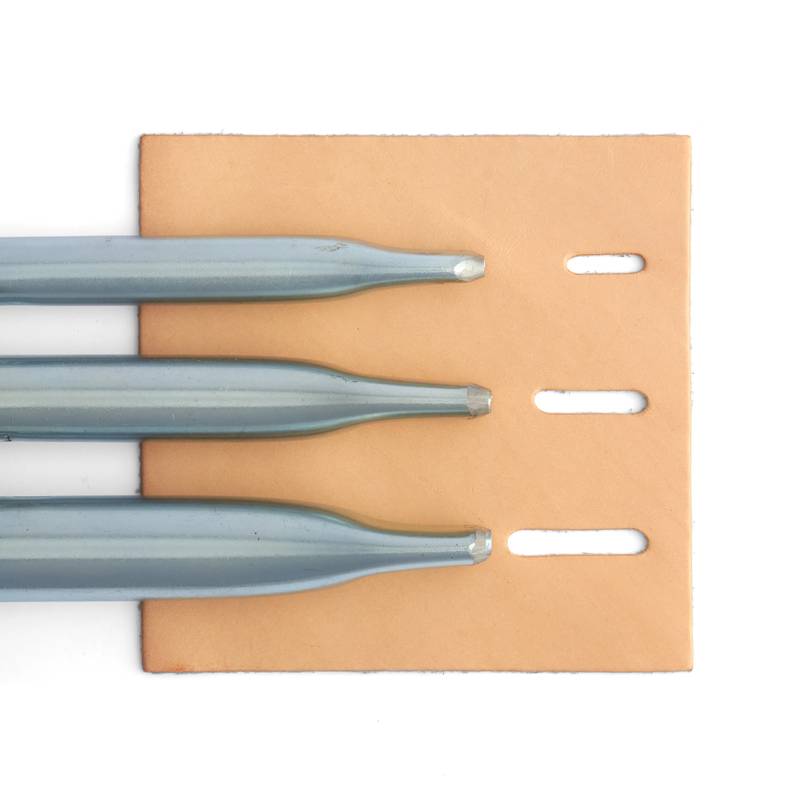
This basic steel oblong punch is designed to create the slot for a buckle tongue. It replaces the need to punch two round holes and cut between them with a knife. The tool is an economical choice for occasional production of leather belts or collars from leather up to 3.5 mm thick.
Material and Features
Hobby-grade construction (tubular steel): the tool is made from basic steel tubing, which significantly reduces its purchase price. It is intended for occasional, non-production use.
Waste ejection opening: a cut-out in the side of the tool allows punched leather scraps to escape, helping prevent the tube from becoming clogged during use.
Clean cut: when used on leather up to 3.5 mm thick, it produces a slot with straight, perpendicular walls. The resulting opening allows the buckle tongue to move freely when fastening.
Notes for Manufacturers
Leather thickness limit (max. 3.5 mm): The tool works reliably on thin and medium-weight leather. Do not use it on material thicker than 3.5 mm. The softer tubular steel may lose its shape or become permanently deformed when punching through such thick leather.
Not suitable for synthetic materials (PVC/TPU): Do not use the punch on webbing coated with hard plastics. The cutting edge is not designed to cut through these tough materials and may be damaged.
Choosing the correct size: The 13 mm dimension indicates the total length of the punched slot. Choose a size that matches the width and profile of your buckle tongue. For other hardware sizes, use the 20 mm or 25 mm variants.
Recommended Add-ons
Carriage Hand Sewing Wax #2015-00 and Poly Cutting Board #3464-00 for maximum protection and a longer-lasting cutting edge. We recommend using the Steel-Plastic Mallet with Wooden Handle #3303-11 to avoid damaging the striking surface of the tool.
How to Use Punching Tools Correctly
Watch our video guide to see the correct technique for precision punching leather in practice. We’ll show you how to achieve a clean, perpendicular cut and cover the key rules for protecting your tools – from using the right protective cutting board to choosing a suitable polyurethane mallet that will not deform the striking surface.
Pantone Colour
NoneNoneThe number refers to the closest PANTONE® colour. On-screen colour is only a guide; use a physical PANTONE® guide when an exact match matters.