Go to content | Go to main menu | Go to search
You are here: Pet Hardware Webbings Rubber Tracer Webbings Rubber Webbing – Black / Sky Blue
 New
- 10 %
Clearance
New
- 10 %
Clearance
New
Reduced price
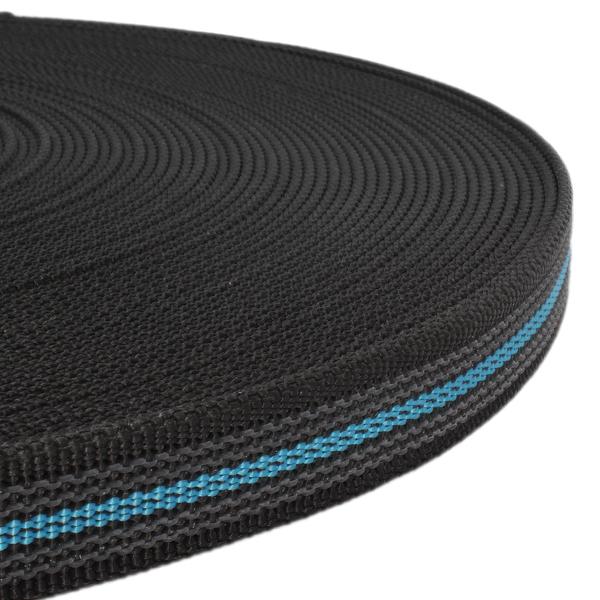
This polypropylene webbing is made with anti-slip rubber threads, so it will not slip out of your hand even in demanding conditions. It suits training leashes, long tracking lines, sled dog harnesses, horse halters, and any products where you need a firm and secure grip in all weather conditions.

This webbing is a legend among manufacturers of dog gear, but working with it requires a specific approach. The combination of plastic fibers and latex rubber demands special attention, especially when stitching and melting holes.
Stitching instead of riveting. For this type of webbing, I strongly recommend stitching (ideally the X-box stitch). Do not use rivets on rubberized webbing – a rivet does not have sufficient grip in plastic fibers and may cut through the rubber threads, which can then start protruding from the webbing in an unattractive way.
Melting holes. If you need to create a hole in the webbing, use only a soldering iron or a hot tip. When melted, the rubber threads fuse together with the polypropylene, securing the hole. If you punch the hole with a standard hole punch, the rubber will loosen at the cut point and the webbing may begin to deform and fray around the opening.
Sealing the ends. Do not forget to heat-seal every cut immediately with a hot knife or a lighter. This is essential to “lock” the rubber threads inside the weave and prevent them from working their way out of the webbing.

Enter your email and we'll send you one notification when this product is back in stock. Nothing more.
