Which glue for which material
Most common
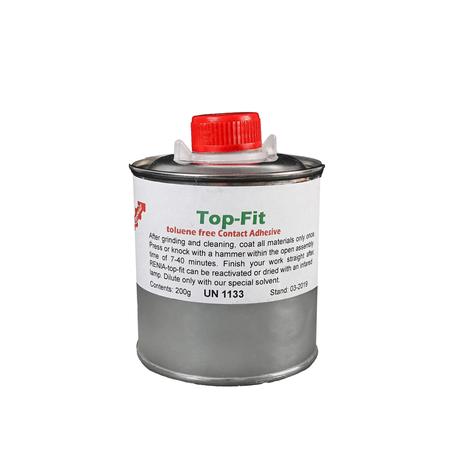
Why this one: fits both materials (Veg-tan leather + Rubber) · very high initial tack, you can keep working on the piece straight away
- Clean or sand the surfaces of both parts.
- Coat both parts until you can see a layer of glue.
- Join the parts within the open time and press them firmly. The technical data sheet gives the pressure and how long to hold it.
The open time of the glue depends on the materials being joined. Exact values and the recommended procedure are in the manufacturer's technical data sheet. · Contact adhesive: apply to both parts · Highly flammable. · Add-on: Renia thinner (thickened glue, cleaning).
Important information on choosing a glue
- The table is only indicative. A glue that suits one material won't necessarily join it to every other material.
- Pick both materials in the calculator above. You'll see the specific glue and its conditions of use, such as surface preparation.
- Test the combination first. Our recommendations come from the glue manufacturers' technical data sheets, not from our own strength tests.
The whole table: material × glue
Click a material to open a short card: what it is, where it's used and what to glue it with.
Suitable: the manufacturer lists the material as suitable for the glue
Suitable with pre-treatment: only with an extra product or surface treatment, the note in the cell says which
Not suitable: the manufacturer says the glue does not bond it
Not verified: the manufacturer doesn't mention the material, so we can't confirm the glue suits it
A contact adhesive is applied to both parts, so it has to suit both materials.
| Material | Aquilim 315water-basedManufacturer's technical data sheet | Colle de ColognecontactManufacturer's technical data sheet | Top-FitcontactManufacturer's technical data sheet | Loctite 401 / 454 GelinstantTechnical data sheet Loctite 401Technical data sheet Loctite 454 Gel |
|---|---|---|---|---|
| Vegetable-tanned leather (veg tan) | Suitable | Suitable | Suitable | Suitable |
|
||||
| Chrome-tanned leather (chrome tan) | Suitable | Suitable | Suitable | Suitable |
|
||||
| Textile / fabric | Not verified | Suitable | Not verified | Suitable |
|
||||
| Felt | Suitable | Suitable | Suitable | Not verified |
|
||||
| Cork | Suitable | Suitable | Suitable | Not verified |
|
||||
| Natural rubber | Suitable | Suitable with pre-treatmentonly with Renia Hardener C | Suitable | Not verified |
|
||||
| Synthetic rubber (TR, Vibram soles) | Not verified | Suitable with pre-treatmentonly after Renia Rehagol | Suitable with pre-treatmentclean with acetone; not all TR types | Not verified |
|
||||
| EVA foam | Suitable | Suitable | Suitable | Not verified |
|
||||
| PVC / vinyl (incl. PVC-coated waterproof webbing) | Not verified | Suitable | Not suitable | Not verified |
|
||||
| Polyurethane foam (PUR, e.g. Poron) | Suitable | Suitable with pre-treatmentonly with Renia Primer for PUR | Suitable with pre-treatmentonly with Renia Primer for PUR | Not verified |
|
||||
| Solid polyurethane (PUR soles) | Not verified | Not verified | Suitable with pre-treatmentonly with Renia Primer for PUR | Not verified |
|
||||
| Polyethylene (PE) | Not verified | Suitable with pre-treatmentonly after flame treatment | Suitable with pre-treatmentonly after flame treatment | Not verified |
|
||||
| Polypropylene (PP) | Not verified | Suitable with pre-treatmentonly after flame treatment | Suitable with pre-treatmentonly after flame treatment | Not verified |
|
||||
| Polystyrene | Not verified | Not verified | Not verified | Not verified |
|
||||
| Latex | Not verified | Not verified | Not verified | Not verified |
|
||||
| Metal (rings, rivets, tags) | Not verified | Suitable | Not verified | Suitable |
|
||||
Related tools
- Leather colour chart Real leather sample discs for every dye, antique finish and Angelus paint we stock.
- Leather thickness converter Convert leather thickness oz to mm, with product recommendations and links to matching leather in stock.
- Leather guide A short course on leather types and an explanation of what leather names mean, with links to matching leather in stock.
- Materials Properties of every material side by side: strength, weight, corrosion resistance and water.
- Surface finishes Surface finishes side by side: look, abrasion resistance, nickel content and damp conditions.